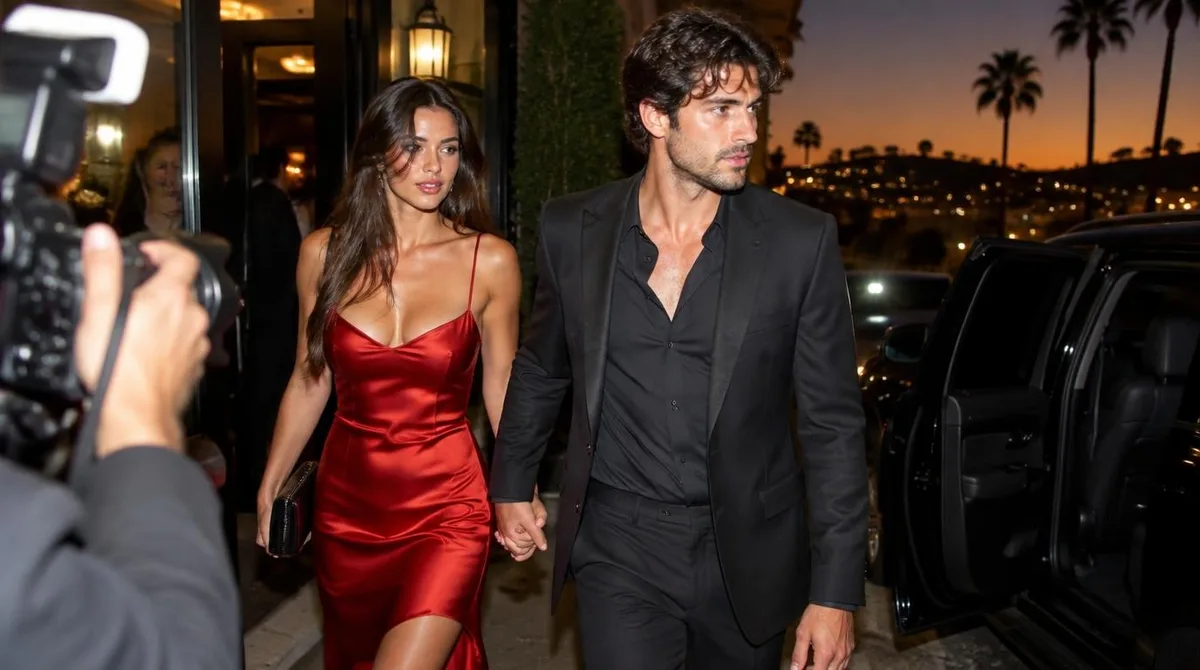
When a celebrity relationship becomes public, it happens in stages, and each stage has a confirmed version. A couple may be photographed together, appear side by side at an event, post each other on a verified account, or have a representative speak on the record. Until one of those things happens, the relationship remains unconfirmed, no matter how many headlines it generates.
The pattern holds across the industry. A representative's on-record statement carries the most weight, followed by the star's own verified post, followed by named published reporting. What never counts is an unnamed source. This guide walks through the confirmed stages, from a first sighting to a formal statement, and explains why the confirmation matters as much as the romance itself.
What does a soft launch look like when the couple is famous?
The earliest confirmed stage is usually a photograph, not a statement. Two people appear at the same event, sit in the same row at a show, or are photographed leaving the same restaurant. On its own, that proves presence, not romance. Coverage that treats a shared doorway as a confirmed couple is speculation, and readers can tell the difference by asking one question: who, by name, has said these two are together? This connects to our earlier piece, Dove Cameron and Damiano David Confirm Engagement After Two Years.
Some couples stay in this stage for years. Others move through it in weeks. The pace is the couple's choice, and the confirmed record respects it. A red carpet appearance together is a milestone worth reporting precisely because it is public and on the record — the event is named, the date is known, and the photographs exist. That is a different thing from a story built on interpretation.
Why is a representative's statement the strongest confirmation?
A representative speaking on the record is the clearest form of confirmation in show business. The statement names who is speaking, who they speak for, and usually which outlet received it. Everything after that sentence is reporting, not guessing. The same structure works at the other end of a relationship. When a couple separates, the rep statement is often the first confirmed word, and outlets report it the same way: who said it, to whom, and when.
Named outlets have documented this pattern repeatedly. According to E! Online, months passed between a representative addressing Margaret Qualley and Jack Antonoff's breakup and the couple's divorce filing, showing how a rep statement and a legal step are two separate confirmed events. A rep confirms the relationship fact; the court record confirms the paperwork. Neither substitutes for the other, and careful coverage keeps them distinct.
What role does the star's own verified account play?
A post from the star's own verified channel is first-party confirmation. The person is the source. A couple appearing in each other's photos, a caption that names the partner, or a milestone shared directly all count, because the account belongs to the person making the claim about their own life. No intermediary is needed and no translation is required.
This is why verified posts are treated as the second-strongest source, just behind a rep statement. A rep speaks for the star; the star speaks for themselves. Both are on the record. What a verified post cannot do is confirm something about someone else — a partner's family, a co-star's feelings, a third person's private life. The confirmation power stops at the edge of the person's own story. For related coverage, see How Celebrity Representatives Confirm Splits, From Statement to Press.
How do unconfirmed rumors get handled — and why does it matter?
Rumors move faster than confirmations, and the confirmed record is the antidote. A rumor with no named origin gets labeled unconfirmed or left out. Even a rumor with a named origin stays a rumor until the people involved or their representatives speak. Readers benefit from knowing exactly which category a story sits in.
Wedding speculation shows the pattern in action. According to E! Online, Tim McGraw weighed in on speculation that he performed at Taylor Swift and Travis Kelce's wedding, saying of the couple, "We couldn't be happier for her to find Travis," while shutting down the rumor about his own role. Note what happened there: a named person, speaking on the record, addressed a rumor and corrected it. The quote is confirmed. The wedding detail it addressed was not, and the reporting kept those two facts separate.
What happens when a couple never confirms at all?
Silence is a choice, and the confirmed record honors it. Some couples simply never issue a statement, and coverage then rests on what is public: joint appearances, shared projects, and anything the pair has chosen to share themselves. Absence of a statement is not evidence of anything — not a breakup, not a secret, not a feud. It is absence of a statement.
The practical takeaway for readers is simple. When a headline claims a celebrity couple is together, engaged, or done, check whether the story names who confirmed it. If the answer is a representative, a verified post, or a named outlet's reporting, the claim has a foundation. If the answer is "sources close to" anyone, the claim has none, and the publication printing it has told you something about its standards.
What this means for how to read relationship news
The stages are consistent: a sighting, a joint appearance, a verified post, a rep statement. Each one moves a relationship further into public record, and each one can be checked. The celebrity economy runs on attention, and fame itself has always been built on media coverage — as histories of celebrity from the 18th century onward show, public fascination with famous private lives long predates the internet. What has changed is the machinery of confirmation: today, a single verified post can settle what once took a columnist's phone calls.
Our analysis of the confirmed patterns is that the strongest stories are also the simplest ones. A named person said a named thing to a named outlet, and the reader can trace every step. That standard protects the people in the stories and the people reading them. Romance is the fun part; confirmation is the part that makes it news.